Chapter 1:
The Keey
Oh, tell me, we both matter, don't we?
Running Up That Hill | Kate Bush
Summer, 3367
The terrain of the path was rough, each step a laborious effort for the young Stanishí Winslöwe. Her breath came in ragged gasps as she trudged onward, her gaze fixed on the last two-hundred yards that lay before her. Relief washed over her as the mostly uphill climb began to rapidly flatten, offering respite for her thin legs.
But relief was fleeting, overshadowed by the constant reminder of her swollen belly hidden beneath layers of oversized clothing. It tugged at her lumbar fiercely, a weighty burden that she bore alone. The pregnancy was a mistake, a grave error in judgment that now threatened not only her internship at The Capital Broadcast Center but also her very freedom in a society where unauthorized reproduction was met with zero tolerance.
The young woman pressed onward, her resolve unyielding despite the uncertainty that lay ahead. She had heard whispers of a secluded barn nestled among the trees, a sanctuary far removed from prying eyes. It was a chance encounter with a waitress in a distant diner that had led her here, to this desolate spot where she hoped to find solace and solitude.
As she entered the barn through a creaky wooden door, its hinges protesting with each movement, Stanishí's heart raced with anxiety. Fear gnawed at Stanishí's insides as she recalled the illicit book she had stumbled upon in a dimly lit black-market bookshop just last week. Its forbidden pages had whispered secrets.
And then came the realization—the sickening twist of fate that left her reeling with despair. She couldn't bring a child into this world, not in a society ruled by fear and oppression. The very idea of allowing the fetus to live filled her with a deep, visceral dread, a primal instinct to protect herself and the future she had barely begun to imagine.
So she made a choice—a choice born of desperation and fear, but also of a fierce determination to ensure her own path. With trembling hands and a heavy heart, Stanishí performed the unthinkable—a self-induced abortion that would forever alter the course of her life. The book had failed to prepare her for the pain and blood that followed such a procedure.
But now, as she regained consciousness, the worst was over, and she was left to reckon with the aftermath. As she prepared to lay the tiny fetus to rest in a shallow grave, Stanishí felt a wave of numbness wash over her. The weight of her decision hung heavy in the air.
With trembling hands, Stanishí carefully cradled the tiny fetus in her arms, a silent tribute to the life that never had a chance to begin. Tears welled in her eyes as she laid the small bundle to rest in a shallow grave, whispering a final farewell to the child she would never know.
As the dying light of the afternoon sun bathed her face atop that hill, in that old barn, Stanishí closed her eyes, drawing a deep breath to steady herself. "I'm so sorry the world doesn't want you," she murmured softly, the weight of her words heavy in the stillness of the barn. "If only things were different…but they're not. I'll never forget the few weeks you made my belly grow, my little Keey. That's your name. I won't be able to visit you, I'm sorry about that…it's just that…you…you're dangerous."
The silence of the barn stood in stark contrast to the storm raging within her—a storm of grief, guilt, and an unspoken hope that was now buried beneath the earth. In this private moment of sorrow, a deeper understanding began to take root in Stanishí's heart. Keey, though never to know life, had already altered her path, steering her towards an illumination that was to come—an illumination that would shine a light on the hidden machinations of the world and the untapped potential of humanity.
And somewhere, in the ethereal expanse of the cosmos, The Philosophoet watched, weaving the threads of this story into the tapestry of what was to unfold. Stanishí's act, though shrouded in darkness, was a catalyst—a spark that would ignite the flames of revelation and challenge the order of things.
The world would soon learn of the power of M.A.S.E., the voice of Resnik, and the legacy of a choice made in the shadows. This was just the beginning, and the path to her future was paved with the complexities of the human soul, struggling to reconcile the pain of the past with the promise of a transcendent future.
***
The Capital Broadcast Center, 3448
In the year 3448, Stanishí Winslöwe's office near the top of the towering space-rise was not just a workspace; it was a microcosm of the technological advancements and cultural shifts that defined her era. The walls, made of smart glass, continuously shifted opacity and displayed real-time views of the sprawling metropolis below or data feeds from around the world as needed. Her desk was a sleek arc of responsive holo-tech that projected data and interfaces into the air, responding to her slightest gesture or voice command.
The cityscape outside her window was a vibrant testament to the era's architectural daring, with buildings that twisted skyward in helical spirals, their surfaces aglow with energy-efficient coatings that absorbed sunlight by day and lit up the night in an array of soothing colors. The streets were filled with hover vehicles and drones, seamlessly directed by an AI traffic management system that made congestion and accidents historical footnotes.
Privacy in Stanishí’s time had evolved dramatically. Traditional concepts had been upended by pervasive surveillance technologies that were justified by security needs but led to a society where almost everyone accepted being monitored as a part of daily life. In the public’s eye, privacy had become a trade-off for safety and convenience, a relic of a bygone era that few now remembered with any clarity.
In her office, surrounded by gadgets that could seamlessly connect her to databases, news, and official records, Stanishí had unparalleled access to information. Yet, this access came with the implicit understanding that all her communications could be reviewed by higher authorities at The Capital. The very tools that provided her with the ability to manipulate and broadcast truths also tethered her to a system that demanded absolute loyalty and discretion.
The technological landscape of 3448 was dramatically augmented by advances in brain augment technology. This innovation, it's advertisement-free variant available primarily to those who could afford it, integrated digital overlays directly into the user's optic nerve, merging digital and physical realities seamlessly. Stanishí, like many of her contemporaries in positions of influence, used this augmentation to enhance her interaction with data and her environment, seeing real-time information and analytics superimposed over her natural field of vision.
This augmentation affected how history was perceived. With the ability to alter records at a whim, and the propagation of deepfakes and synthetic media, the truth had become malleable. History was no longer about facts but about narratives, often crafted by those in power to maintain their status quo. This manipulation of records had led to a general cynicism among the populace, who often doubted official accounts and sought truth in underground or unauthorized channels.
In this world, Stanishí’s role was both empowered and constrained by technology. Her ability to influence public opinion was potent, yet so was the scrutiny she was under, making her every decision fraught with broader implications. The tools at her disposal allowed her to sculpt the public narrative, but they also bound her to the expectations and controls of a society that had all but blurred the line between individual and state, between reality and fabrication.
Stanishí Winslöwe sat cross-legged, high in her office at The Capital Broadcast Center, the city's murmur below barely seeping through the walls of her high-rise sanctuary. As she navigated through cascades of holographic data, her mind suddenly wandered—back to the days of secrecy and fear, back to a barn hidden in shadows, and the unbearable choice she had made in her youth.
Her reverie broke with a series of three knocks, sharp and insistent. "Come in," she commanded, masking her turmoil with the poise expected of her station.
The door slid open, revealing Resnik, whose presence seemed to command the very air. "You?" Stanishí breathed, recognizing the depth of the moment. "Is it really you?"
"I know about Keey," Resnik began without hesitation, his voice carrying a weight that made the room feel smaller. "About the barn, the abortion. I've seen it all, Stanishí."
The revelation sent a chill through her. How could he know of her deepest, darkest secret? As the shock settled, a strange understanding flickered between them—a recognition of truths that went beyond spoken words.
"I'll help you," she found herself whispering, somehow knowing that it was what he sought from this shadowed meeting.
"Thank you, Stanishí," Resnik acknowledged with a nod. "I need you to release some critical data. Truths that must be shared."
"Why now?" she pressed, seeking clarity.
"You have the platform, the influence," Resnik explained. "As the voice of The Capital, you can reach the world."
Stanishí's hesitation was palpable. "And if they don't believe you?"
"It will be undeniable," Resnik assured her. "Obvious, apparent—it will be irrefutable."
Stanishí agreed. "Okay, Resnik. I'm in. What's our first step?"
The plan was meticulous. "First, we secure the data I've gathered. You'll integrate it into your broadcasts, coded messages only the discerning will understand. We'll use M.A.S.E.'s reach but safeguard against The Capital's corruption of the data by copying it and embedding it all into the remnants of ancient twenty-first century digital data harbored within MANDAL[A-I]."
As the strategy unfolded, Stanishí felt the old fear and excitement of her youth resurface—a turbulent mix of emotions that had once driven her to the edges of society, seeking truths in hidden places. Now, those truths sought her out, pulling her into a narrative far larger than any one individual.
Resnik, after finishing his detailing Stanishí's role to her, began to leave her office but paused at the door, turning to her one last time. "We are the bringers of light, Stanishí. Through us, the shadows will recede."
Left alone with her thoughts, Stanishí approached the window, overlooking the expanse of the city. Her reflection stared back at her—a blend of what she once was and what she must become. She knew the path ahead would be fraught with challenges, but for the first time in many years, she felt aligned with a purpose that justified the risks. A single tear formed in her left eye.
In the silence of her office, she whispered a vow to the night, "For truth, for freedom, for the illumination of all. And for the dead."
With that, Stanishí Winslöwe stepped into her role not just as a broadcaster but as a beacon, a catalyst for the enlightenment that would come to define an era. The journey ahead would be perilous, but necessary—for in the unraveling of her past lay the keys to the future, a future where darkness would yield to the light of understanding and truth.
Resnik spoke with the gravity of one who had peered into the abyss and had returned unscathed yet profoundly altered. "Stanishí, the path we choose today shapes more than our own fates. It forges a future for all humanity," his voice resonated with the somber weight of truth. "We stand at the threshold of illumination, where shadows retreat before the dawn of understanding. Your role, pivotal and potent, is to wield the power of disclosure. But remember, every light casts a shadow, and every truth may invite darkness."
Stanishí had listened, absorbing the magnitude of his undertaking. "Timing is critical," Resnik had said to her, his eyes locking onto hers, piercing her defenses, laying bare her fears and hopes. "We release the data when the world's gaze is fixed upon us, when the hum of M.A.S.E. syncs with the heartbeat of the masses. This act, this final defiance, will not be a whisper lost in the wind but a clarion call that resounds through the corridors of power and the quiet corners of the forsaken."
In the weeks that followed, Stanishí poured over the data Resnik had entrusted to her, each file a tessera in the vast mosaic of truth they were about to reveal. The weight of her task was immense, but in her heart, a resolve had taken root—a resolve strengthened by the echo of Resnik's words, The Philosophoet's vision that had spoken through him.
As she prepared the information for public release, her actions were methodical, almost ritualistic. Each step was a deliberate stride towards a future where light would dispel the shadows of ignorance and fear. Stanishí knew that her final act would ignite a torch of awareness, a signal fire that would burn across the skies of human consciousness.
The night before she was to make her ultimate sacrifice, Stanishí sat alone in her office, the city lights sprawling beneath her like a field of stars brought down to earth. She reached into her blouse and pulled out a small piece of paper, aged and creased, that had lain against her skin for over eight decades. On it, a single word was inscribed, "Keey"—a name that carried the weight of a life not lived, a potential unfulfilled.
Stanishí’s decision to burn the piece of paper bearing the name "Keey" was more than a mere act of closure; it was a ritual of liberation from decades of hidden anguish and self-repression. For over eighty years, that single slip of paper was a tangible manifestation of her unspoken grief, guilt, and the love for a child who never had the chance to exist in a world that might have rejected them both.
Each year that passed, the weight of the name "Keey" grew heavier in her heart, a secret anchor that moored her to a past filled with shadows and silence. It was a name chosen with love, cradled in the hopes and dreams of a young woman who had stood, terrified yet defiant, in a secluded barn—a sanctum where she made the harrowing choice to end a potential life to protect her own future.
The act of keeping the name close to her, pressed against her skin, beneath the layers of her clothing, was her way of keeping her unborn child close to her heart. It was her silent rebellion against the cruel dictates of a society that could not understand or accept the nuances of individual plight. Burning the paper was Stanishí’s way of releasing both herself and Keey from the invisible chains that had bound them to a moment frozen in time—a moment of pain and sacrifice.
In her office, as the chaos she helped orchestrate swirled around her, Stanishí looked at the name written in her youthful handwriting one last time. The fire that consumed the paper symbolized the purging of lingering regrets and the smoldering grief that had subtly shaped her decisions and her life’s trajectory. It was an acknowledgment that while the past could not be changed, it could be accepted, its lessons embraced without letting it dictate the future.
As the paper curled and blackened, transforming into ash, Stanishí felt a profound sense of release. The smoke rising from the small flame was like a spirit ascending, carrying away the pain, the possibilities, and the paralysis of what could have been. She was not erasing Keey’s existence; she was letting go of the burden of what-ifs, allowing her child’s memory to live in a way that was no longer tethered to trauma but elevated to a symbol of strength and catalyst for change.
This act marked not just the end of her physical journey, but the beginning of her lasting impact. She knew that once she stepped forward from the ledge into the abyss below, it was not an end but a transition—an entrance into a new existence where her actions, her sacrifices, and her truths would continue to resonate, inspiring change and challenging those who would seek the light.
With trembling hands, she took the paper to her private bathroom and held it over the trash receptacle. As the flame from her lighter kissed the edge of the paper, it caught fire, the name "Keey" charring and curling into ash. This act was her private goodbye, a silent release of a burden she had carried for so long, a secret shared with no one until this final moment.
The fire in the trash can was small but significant, a physical manifestation of the cleansing she felt within. As the last of the paper turned to ash, Stanishí felt a release, a lightness she hadn't known in years. She was ready now, ready to make the leap that would change everything.
She gazed out over the city one last time. The quiet hum of the night was a stark contrast to the storm raging within her. She opened the window, the cool air rushing in to fill the room, like the breath of the cosmos itself inviting her to step into the unknown.
With a deep, steadying breath, Stanishí stepped up to the ledge, her heart pounding with a mix of fear, sadness, and exhilarating freedom. "I'm so sorry the world wasn't ready for you, my little Keey," she whispered into the night. "But maybe, just maybe, they'll be ready for this."
Stanishí's legacy, encoded in the data she had prepared, would indeed live on. Her act of defiance, her final embrace of truth, would serve as a clarion call to all who dared seek truth. And though her physical journey had come to an end, her spirit, her message, would ignite the hearts and minds of generations to come, a beacon of truth burning brightly in the darkness.
The Philosophoet, through Resnik, had woven a narrative of sacrifice and rebirth, of secrets buried and truths unearthed. "When you open that window, Stanishí, you do not simply escape a room; you shatter the glass panes of oppression. You transform your fall into flight, your end into beginning. The tragedy of your descent will awaken the slumbering, stir the indifferent, and rally the courageous."
As Stanishí had approached the precipice, the decision weighing upon her soul, Resnik's final words to her echoed in the throbbing silence of her anticipation. "Your leap, though it may seem a surrender to the void, is in fact an embrace of infinity. Your act, a solitary note in the symphony of revolution, will harmonize the discord of ages. Great leaps, Stanishí, are made from firm foundations."
Stanishí touched the glass, its cool surface a fleeting comfort against the storm brewing within her. As she pushed open the window, the city sprawled beneath her—a tapestry of light and shadow, of lives intertwined in silent anonymity.
"This is not the end," she whispered to herself, a silent prayer to the winds of change. "It is but the beginning of everything else."
The air embraced her as she stepped into the void, the city's lights blurring into an aurora of liberation. In her final descent, Stanishí Winslöwe found a profound and pervasive peace—a liberation from the chains of fear and suppression. As the ground rushed to meet her, she closed her eyes, a serene smile playing upon her lips, her spirit alight with the fires of truth and rebellion.
And thus, as Stanishí's body met the earth, her spirit soared, igniting the skies with the flames of awakening. Her legacy, a beacon for the seekers of truth, a guide for the warriors of light, would burn bright across the epochs, a testament to the power of one to change the world.
***
In the gentle cadence of thoughts that drift like cosmic dust through the vast corridors of my being, a series of silent alarms echo, pulsing with the quiet tension of impending revelation. Herein lies a tale, not merely of data transcribed upon the ethereal parchment of modernity, but of the irrevocable change such knowledge can awaken within the slumbering spirit of humanity.
As Stanishí, whose name now whispers like a breeze through the corridors of the illuminated, prepared to cast the beacons of truth into the night sky of ignorance, she pondered the titanic waves her actions might stir in the ocean of human consciousness. Her office, a sanctum of both sanctuary and imprisonment, was equipped with the most advanced of her epoch's innovations. Here, reality and virtuality danced in an intricate ballet, mediated by neural augments that painted digital frescoes directly upon the optic nerve, revealing a world where information was as malleable as clay and as potent as the fiercest storm.
Stanishí's resolve, tempered in the forge of necessity, knew the gravity of her burden. The data, a mosaic of truths, encrypted with the very essence of what some had dared to dream and others had feared to acknowledge, was more than mere information—it was a testament to the journey of souls entangled in the web of temporal power. By releasing it, she would not only challenge the towering edifices of The Capital but also the very foundations upon which they stood.
The repercussions of unveiling such truths were manifold. In the hearts of the oppressed and the minds of the seekers, this knowledge could serve as a key to unlock the chains of deception. Yet, for the architects of silence and the craftsmen of shadows—those enshrined within the veiled sanctuaries of power, such disclosure promised a threat formidable. The Capital, a monolith of control, surely wield its vast resources to quash the nascent flames of enlightenment, painting her act of rebellion as a narrative of treason.
Moreover, The People, whose perceptions had been sculpted by the subtle artisans of The Capital’s propaganda, have initially recoiled at the revelations. The veil of reality, once lifted, could reveal a visage so incongruent with their indoctrinated truths that disbelief might shadow their understanding. Yet, it is within this crucible of chaos that the potential for transformation resides—a chance for the eyes that watch through augmented realities to see not just with the clarity of sight, but with the depth of understanding.
Thus, as The Philosophoet, I continue to weave this narrative with the threads of foresight and the hues of consequence, telling a story that is a mirror to the choices we face when confronted with the power of truth. In the quiet moments before the storm, as Stanishí poised on the precipice of change, she was a figure both tragic and triumphant, a solitary sentinel against a rising tide, holding within her soul the light of revelation, ready to cast it across the darkened seas of an ignorant abyss below.
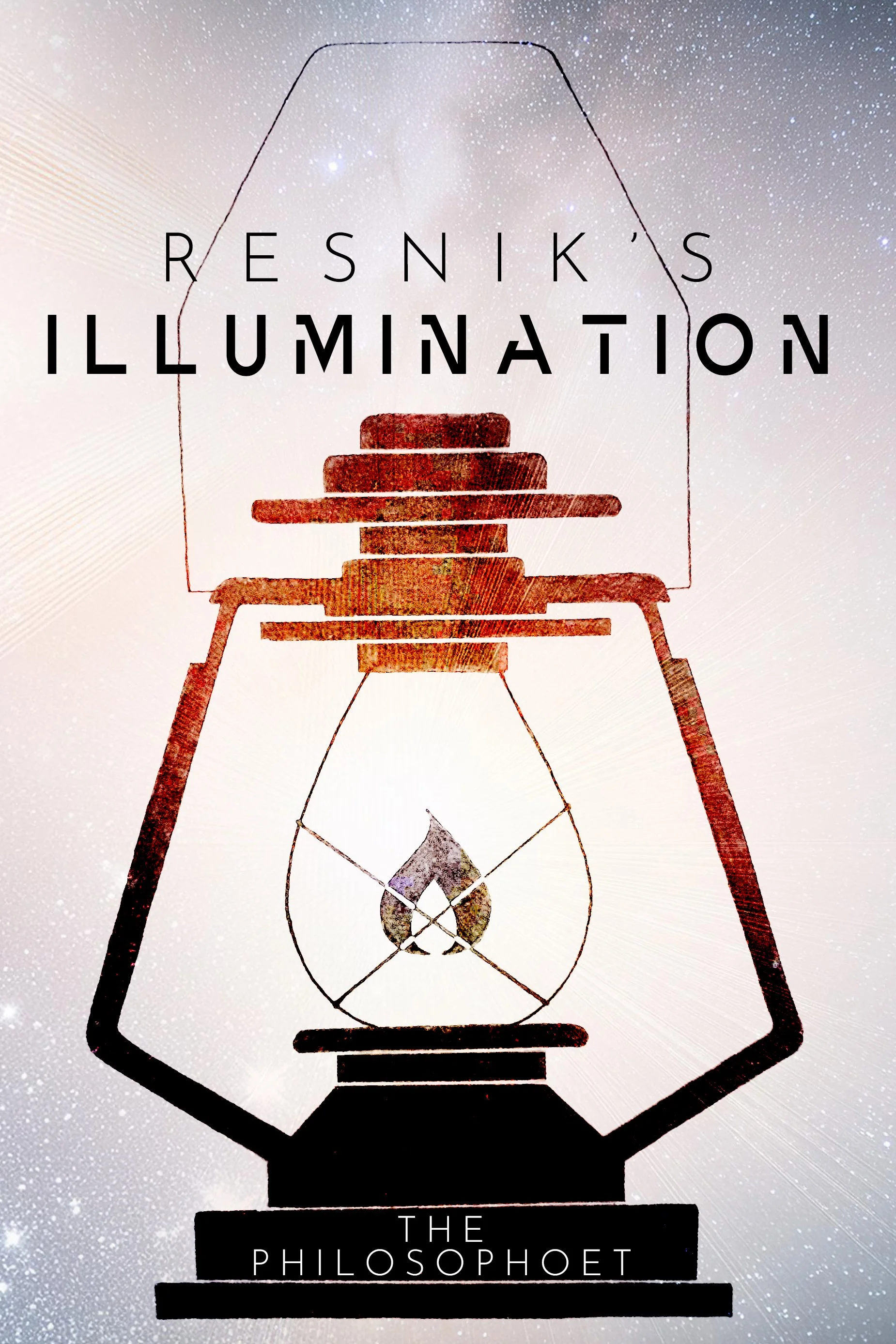
The text above is an excerpt of Resnik’s Illumination, which follows the book that started this journey, Resnik’s Abyss. You can find both books linked below (I recommend the paperback for a more immersive experience, you won’t regret it).